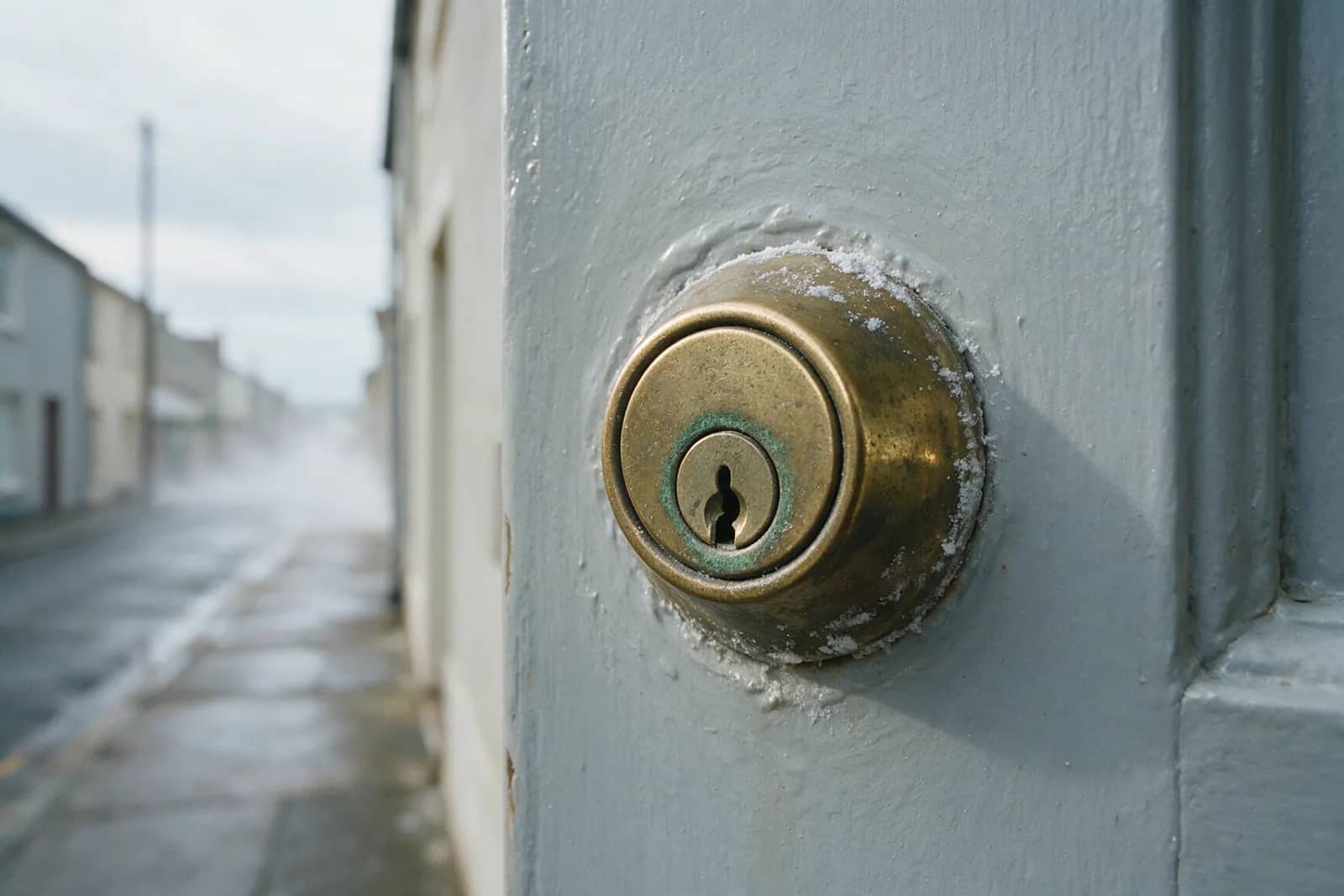
Two identical doors, two different lifespans
Take one deadbolt off a rowhouse on 46th Avenue and an identical deadbolt off a flat on Valencia Street, both fitted the same year by the same builder. Six years later the first one is finished and the second one is unremarkable. Nothing about the doors differs. What differs is four miles of air.
San Francisco is two climates wearing one map. Marine air comes in through the Golden Gate and off the ocean at the western edge, and it carries chloride. East of the hills, in the Mission, Noe Valley, Bernal and Potrero, most of that has fallen out of the air before it arrives. The fog line is not folklore; it is the reason half this city buys locks twice as often as the other half.
Nobody is told this when they buy hardware. The box does not say three years in the Sunset and fifteen in the Mission, and the shop assistant does not either. So people conclude the lock was cheap, or that they were unlucky, when in fact the part did exactly what that part does in that place.
What corrosion actually does inside a cylinder
A pin tumbler cylinder is a stack of small parts that have to slide freely against each other to a tolerance measured in fractions of a millimetre. Pins, springs, the plug and the shell. There is nothing sealed about it: the keyway is an open hole in the front, and whatever is in the air outside is also in the air inside.
Chloride settles on those surfaces and starts pitting them. On a bracket or a hinge, pitting that fine would be cosmetic and nobody would notice for a decade. Inside a cylinder it is the whole tolerance. The pins stop dropping cleanly, the springs lose their snap, and the plug drags in the shell.
That is why the first symptom is stiffness rather than failure. The parts are still moving, only not freely, and a human hand is very good at compensating for that. You start applying a little more force without deciding to, and the lock keeps working, and everyone in the house learns the technique without discussing it.
The schedule, roughly
Year one on a street-facing door within a mile of the ocean: the key goes stiff in the winter and easy again in September. Nothing has failed. A proper strip, clean and lubricate at this stage is a visit rather than a purchase and buys years. Almost nobody calls at this point, which is understandable and expensive.
Year three: the key turns halfway and needs a jiggle. Cleaning stops helping here, because the pitting is in the parts themselves rather than on them. A new cylinder is $28 to $46 fitted into the existing lock. This is the sensible moment and it is the one most often skipped.
Year six: the bolt no longer reaches the strike and the door gets left on the latch, which is where a maintenance problem quietly becomes a security problem. Replacement runs $125 to $319. And at any point along that line, the blade snaps in the keyway on a cold morning, which is a $135 to $249 lockout with an extraction and a new cylinder on the same visit.
What actually helps
Marine-grade stainless instead of plain brass or plated hardware on street-facing doors and anything living outdoors. It costs more once instead of costing you again in five years. This is the only piece of advice on our whole site that we give twice, and it applies to the western half of the city rather than everywhere.
Lubrication with a dry graphite or PTFE product rather than a wet oil, once or twice a year. Wet oil catches airborne salt and grit and holds it against the parts, which makes the problem worse in a way that feels better for a fortnight.
And the honest one: if your key has gone stiff, deal with it in daylight. The gap between stiff and snapped is usually one winter, and the same problem costs $89 on a Tuesday afternoon and $230 at four in the morning with you standing on the pavement.
Quick answers
How far east does this stop mattering?+
Roughly at the ridge. Twin Peaks, Mount Sutro and the hills behind them take most of it out, so the Mission, Noe Valley, Bernal and Potrero run ten to fifteen years on hardware that would be finished in six by the beach. The Marina and Pacific Heights sit in between, taking a gentler salt off the bay.
Is a more expensive brand the answer?+
Less than you would think. Finish beats brand here. A mid-price lock in marine-grade stainless will outlast an expensive one in plated brass on the same door, because what fails is the material rather than the design.
Can a seized lock be saved?+
Sometimes, in the first year or two, with a proper strip and clean. Once the pitting is in the pins and springs, cleaning gives you a lock that works for a month. You will get the honest one of those two answers with the reason attached.
Need it handled rather than read about?
(628) 363-2407